Summer Fruit Tree Pruning
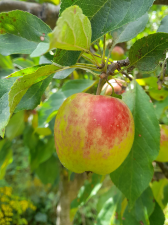
- Summer fruit tree pruning is mainly used for apple or pear trees in trained forms (espaliers, cordons, fans etc). See our guide for more information about fruit tree forms.
- Stone fruits (cherries, plums, peaches) also need to be pruned in summer – this is to prevent disease. This guide focusses on apple and pear trees – we’ll cover stone fruit pruning in future so please come back and check, or join the mailing list.
- Winter pruning stimulates growth; summer pruning slows growth.
- If you’re growing an apple or pear tree as a bush or standard (ie in the shape of a tree!), you can probably just stick to winter pruning.
In this guide, Dan Ori MCIHort runs through how and why we summer prune. We also run regular, free training sessions and workshops at the Seaford Community Orchard and you are very welcome to join us. You can also book a bespoke workshop for your organisation or community group.
Summer pruning key points:
- Usually done in July or August. With climate change we need to be flexible: avoid pruning during periods of drought or prolonged wet weather.
- Prune when new shoots are stiff and woody along their bottom third, with the remaining two thirds still green and flexible
- Summer pruning stops or slows growth – so helps control the size of the tree.
- Encourages the development of fruiting spurs (more important on older, less productive trees).
- Allows the tree to focus its resources on producing fewer, but better quality fruit.
- Removes overcrowded, dead, crossing, damaged or diseased branches, meaning better air circulation and less disease.
- Light pruning only is done – remove no more than one third of growth.
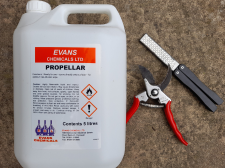
To avoid transfer of disease, sharpen your tools before you begin, and clean tools with disinfectant before pruning, and between pruning each tree. We use Propellar Horticultural disinfectant – but any type is fine. Visit our Tool Sharpening Masterclass to learn more.
Step by step guide
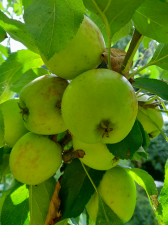
1) Walk around the tree and take a look at it. How is its general health? Are branches crowded or dense? Is it generally symmetrical?
2) Thin any excess fruit. (In the example photograph, we’d just leave one of these apples). For young trees, you might want to remove all fruit in the first year to allow the tree to concentrate its energy on growth rather than fruiting.
3) Next, check for any damaged, dead, diseased or crossing branches and remove them. You can also remove crowded branches, or branches heading in the wrong direction.
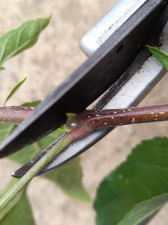
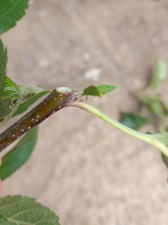
4) Cut fruiting branches back to 2 or 3 buds from where the branch joins the main stem.
5) Always cut just above a bud or a leaf. Aim for a clean, angled cut.