Understanding Rootstocks
Rootstocks are an essential but – at least at first sight – complicated part of fruit tree growing. They affect the size, health and productivity of the tree — and understanding them can help you make the best choice for your garden or space.
Why not just grow from a seed or a cutting?
Although you can grow a fruit tree from a seed, the tree that grows won’t be exactly like the one the seed came from. For example, planting a seed from a Golden Delicious apple won’t give you another Golden Delicious tree. This is because of how fruit trees are pollinated — the seed is a mix of both parent trees. (Find out more on our Understanding Pollination Groups page). You could also grow a fruit tree from a cutting. While this can work, the resulting tree might not grow in the same way as the original — especially if that tree was grafted onto a rootstock.
So what is a rootstock?
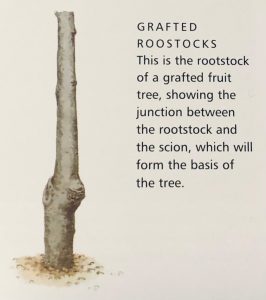
A rootstock is the bottom part of a tree — its roots and the lower section of the stem. This is joined (or grafted) to a piece of another tree, known as a scion. The scion is the variety we want to grow — perhaps one that produces particularly tasty fruit.
For example:
-
The rootstock might come from a small, hardy apple tree that doesn’t produce good fruit.
-
The scion might be from a tree that produces lovely apples, but would grow far too large for a garden.
Put together, they make a tree that’s just the right size and produces the fruit you want.
Image from
Why do growers use rootstocks?
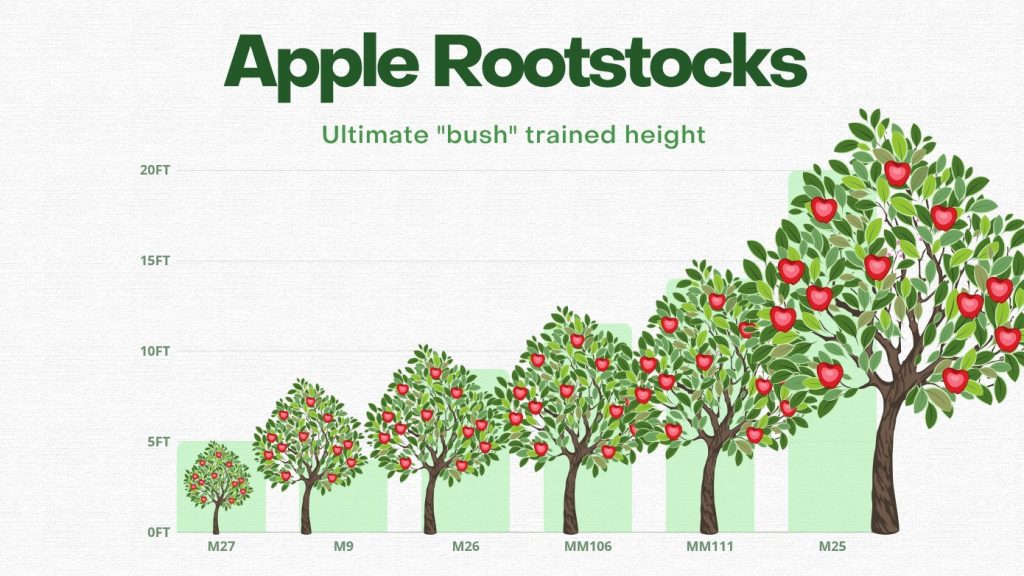
- Size control – Rootstocks help determine how large a tree will grow — from very small (suitable for pots or small gardens) to full-sized orchard trees. So, for example, if you want a particular type of apple tree (such as a Bramley), you can choose both the variety (Bramley) and the size — small, medium or large. This gives you much more choice and flexibility.
-
Reliable results – Trees grown from seed can be unpredictable. Using a rootstock and scion gives you a known variety, with known fruit and growth habits.
-
Better soil tolerance – Some rootstocks are chosen because they can handle certain soil types that the fruit tree variety might struggle with on its own. For example, if your garden has heavy clay or very sandy soil, the tree might find it hard to grow well. But if the fruit variety is grafted onto a rootstock suited to those conditions, the tree is more likely to thrive. Knowing your soil type will therefore help in choosing the right rootstock.
-
Disease resistance – Certain rootstocks are more resistant to pests or diseases, helping the tree stay healthy.
Naming and sizes of rootstocks
Unfortunately, there is no logic in the naming of rootstocks! You’ll see all sort of codes and names such as MM111, Gisela 5, M27…. and there’s no logic or system. So the best thing is to refer to a reference table (unless you’ve got a really good memory). We’ve linked to some reference guides to rootstocks in the further information section below.
More information:
There’s a guide to rootstocks, including comprehensive rootstock types and sizes for different types of fruit trees on the Frank P Matthews website here. There’s also a useful spacing guide, according to rootstocks, on the Orange Pippin website.
At the Seaford Community Orchard, we’ve planted fruit trees on several different rootstocks, including some specifically for local soil conditions. You’re welcome to join us at one of our workshops or get in touch to find out more if you’re planning a community project.