Building raised beds with a water retentive compost mix – a case study
Background:
Tower House, a satellite provision of Cuckmere House School, is dedicated to providing education for 16 boys with Autism and Social, Emotional, and Mental Health needs. The Garden Project initiative undertaken at Tower House aimed to create a special outdoor space for the young people to grow vegetables, herbs and fruit, learn about biodiversity and experience different sensory plants. The school also wanted to keep water consumption low (watering in schools grounds is always a challenge!) A partnership of local groups built and installed 7 raised beds: 4 were planted with sensory and wildlife plants, and 3 with vegetables.
We hope this case study will be of practical use to others wanting to undertake similar projects. We’ve been open about mistakes and what we’d do differently next time! We’ve also linked to further information, local suppliers and where to get more help if you’d like to do something similar.
If you’ve done a similar project – or would like to – have any questions, thoughts or would like more information please get in touch via the contacts form.
Step 1. Assessing the site:
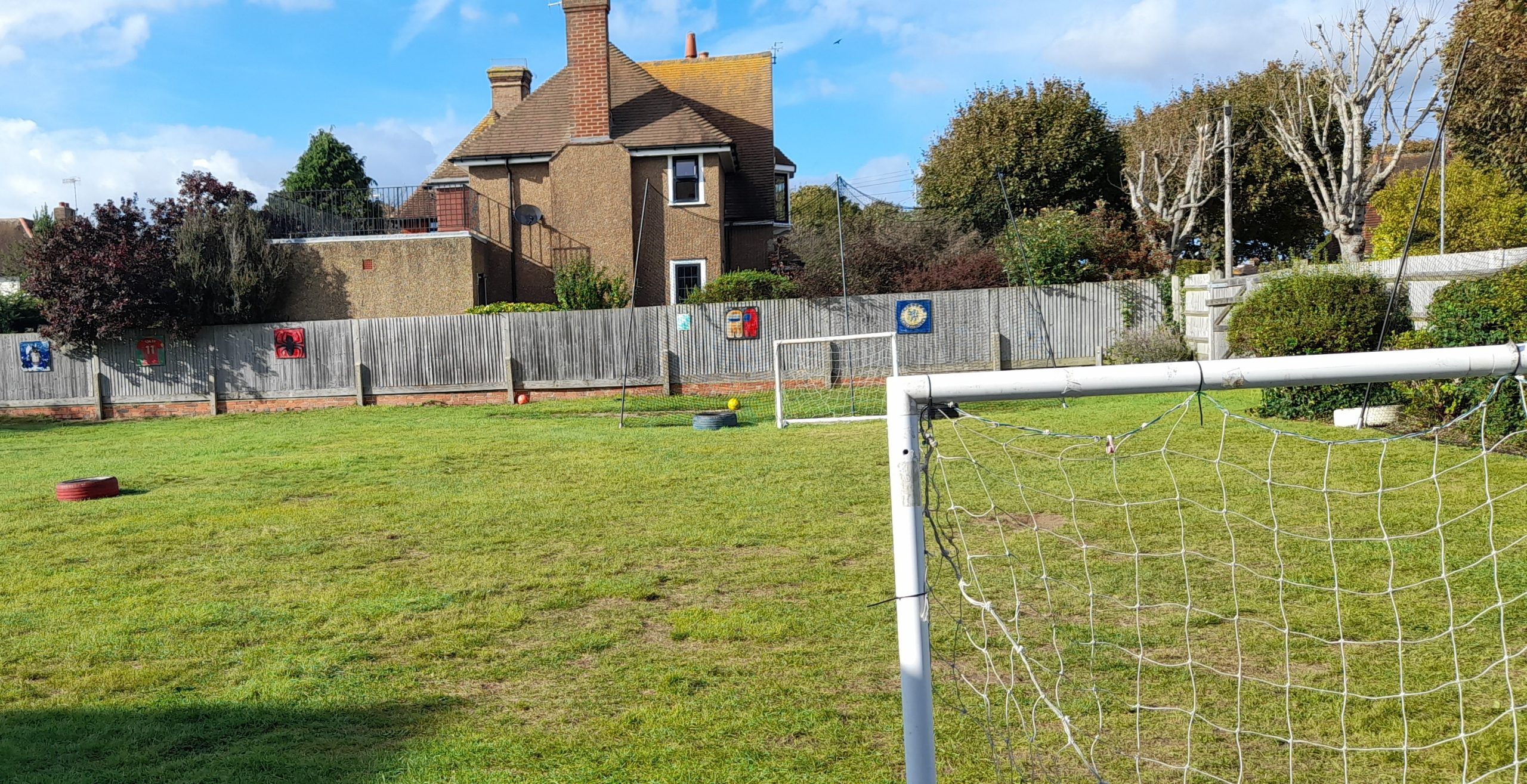
The first step in any gardening project should always be to assess the site – on a public or school site there are additional considerations. Volunteers from Gardening In Action and Seaford Action For Nature visited the school to look at the site with staff. These were some of the factors we considered:
Aspect: ie sun, shade, slopes, soil, wind etc. The school suggested an area along a south-facing fence for the raised beds. Most vegetables, herbs and sensory plants need full sun – although some will grow in semi-shade – so this was ideal. For more information on assessing sites in public spaces please sign up to our mailing list – we’ll be running a working and uploading resources early in 2025.
Water requirements: Sadly, many growing projects in public spaces fail because watering requirements aren’t properly considered. Watering in schools can be a challenge, particularly during holidays. As well as using a compost mix and bed design to reduce water consumption, we discussed who would do the watering and where would the water come from? The school decided this would be done by pupils during term time, and during the holidays, a couple of the teachers, who live nearby, would water the beds. Please visit the module on water and watering for more information.
Accidental damage: damage to school trees and gardens can come via accidental damage from footballs or other games. In other public spaces, this might be via people using a space as a walkthrough, parking vehicles etc. It’s worth looking carefully at how the space is used, and whether any risks need to mitigated by, for example, putting up screens or barriers. We checked this out, talked about how and where the children play, and were happy it wouldn’t be too much of an issue.
Neighbours: sometimes a project can impact nearby neighbours – will trees cause shade or block views? Will there be extra activity which might cause a nuisance. We checked this out and were confident nearby neighbours wouldn’t be affected.
Health and safety and accessibility: we talked through the construction of the beds, the materials to be used and the proposed plants with staff to ensure health and safety requirements had been met and that the beds would be accessible for all pupils and staff.
2. Sizes and dimensions:
For children, a one metre square raised bed is a good size, and means that short arms can reach to the centre of the bed. Larger beds are also possible of course – for example, 2 metres in length and 1 metre wide, but make sure that whoever is using the bed can reach comfortably to the centre of the planting area.
There needs to be at least 1m of space between each raised bed, and between the beds and fences, to allow the pupils to access the beds from all sides. We also wanted to leave some room to plant fruit trees and bushes later on.
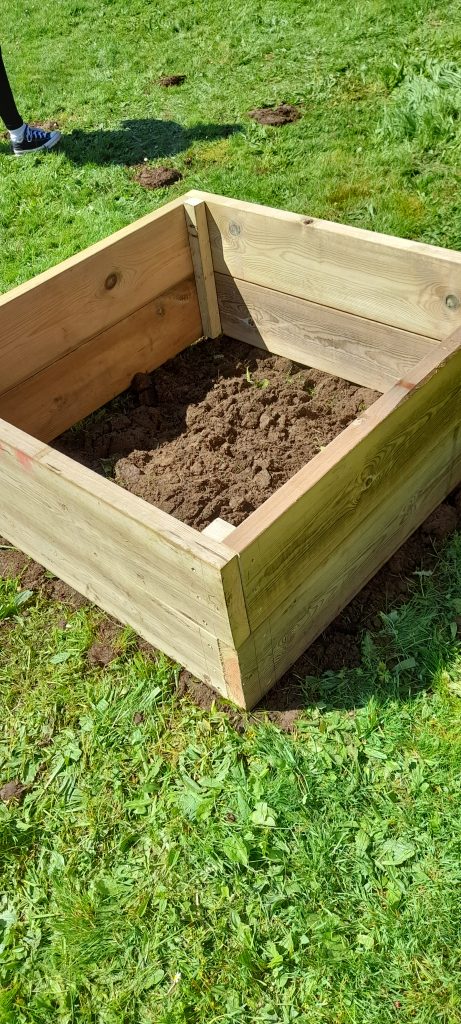
Raised beds can be various heights but we decided to make ours 2 planks high – about 42cm. Deeper beds are more expensive to make, and need more planting media to fill. However, the advantages are that they are easier to use (less bending down) but also the greater volume of planting media or compost means that the beds don’t dry out so quickly, and they don’t heat up so much in summer, or freeze in winter. It also means it’s easier to grow for root vegetables such as carrots or parsnips.
Raised beds can also be built on ‘legs’ – for wheelchair users or people who can’t bend down.
3. Choosing, cutting and preparing the wood:
Raised beds can be made of all sorts of different materials, including reclaimed wood and scaffolding boards. However, there can be a trade-off between the lower cost, and the time it takes to find and prepare reclaimed wood. If you’re growing edible crops, check how the timber was treated. [check with Dan on this]
Volunteers from Wood Creatives chose the following materials:
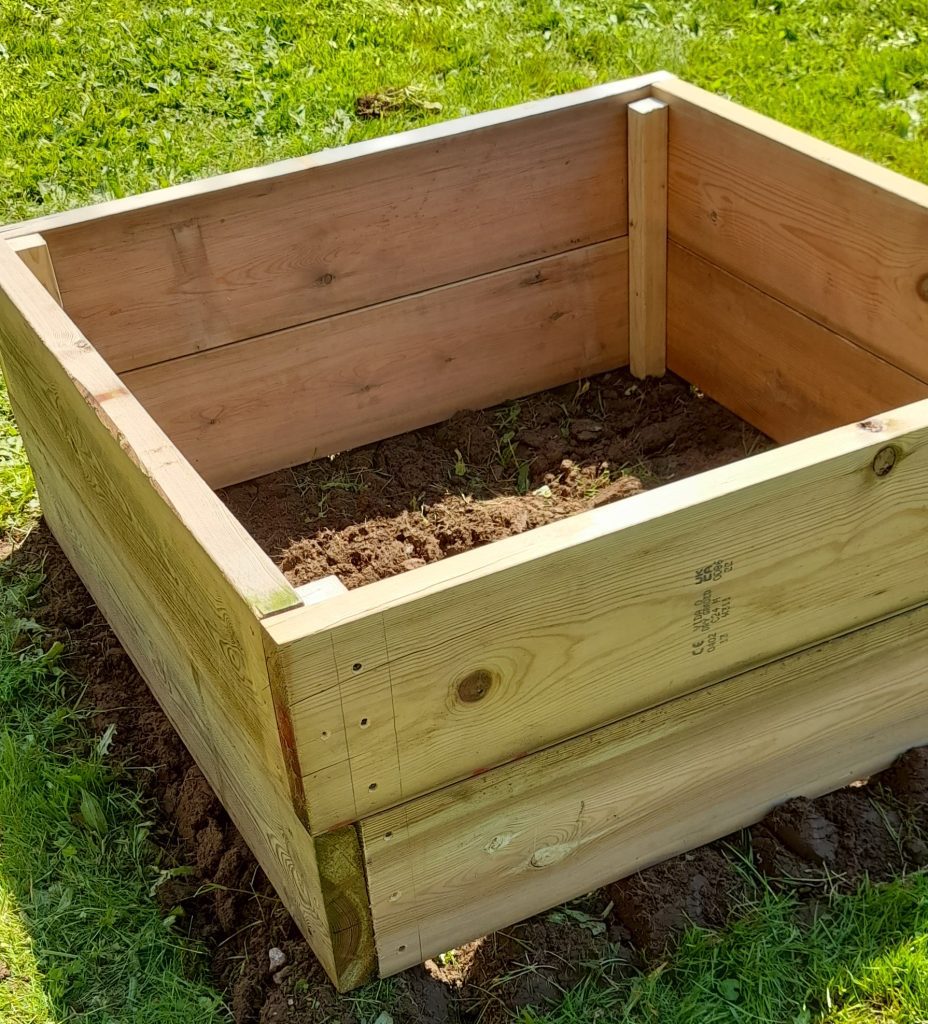
- Tanalised timber planks: 50mm x 225mm x 4200mm (2 for each bed – 14 in total)
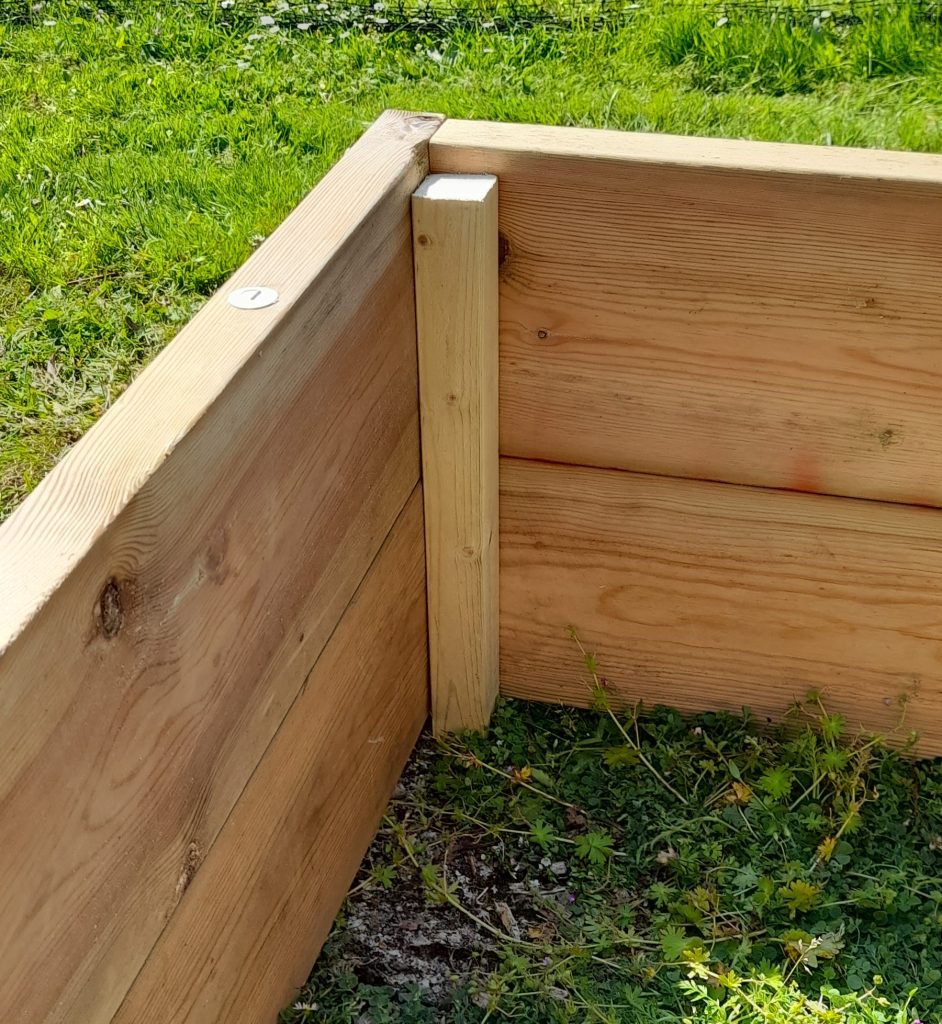
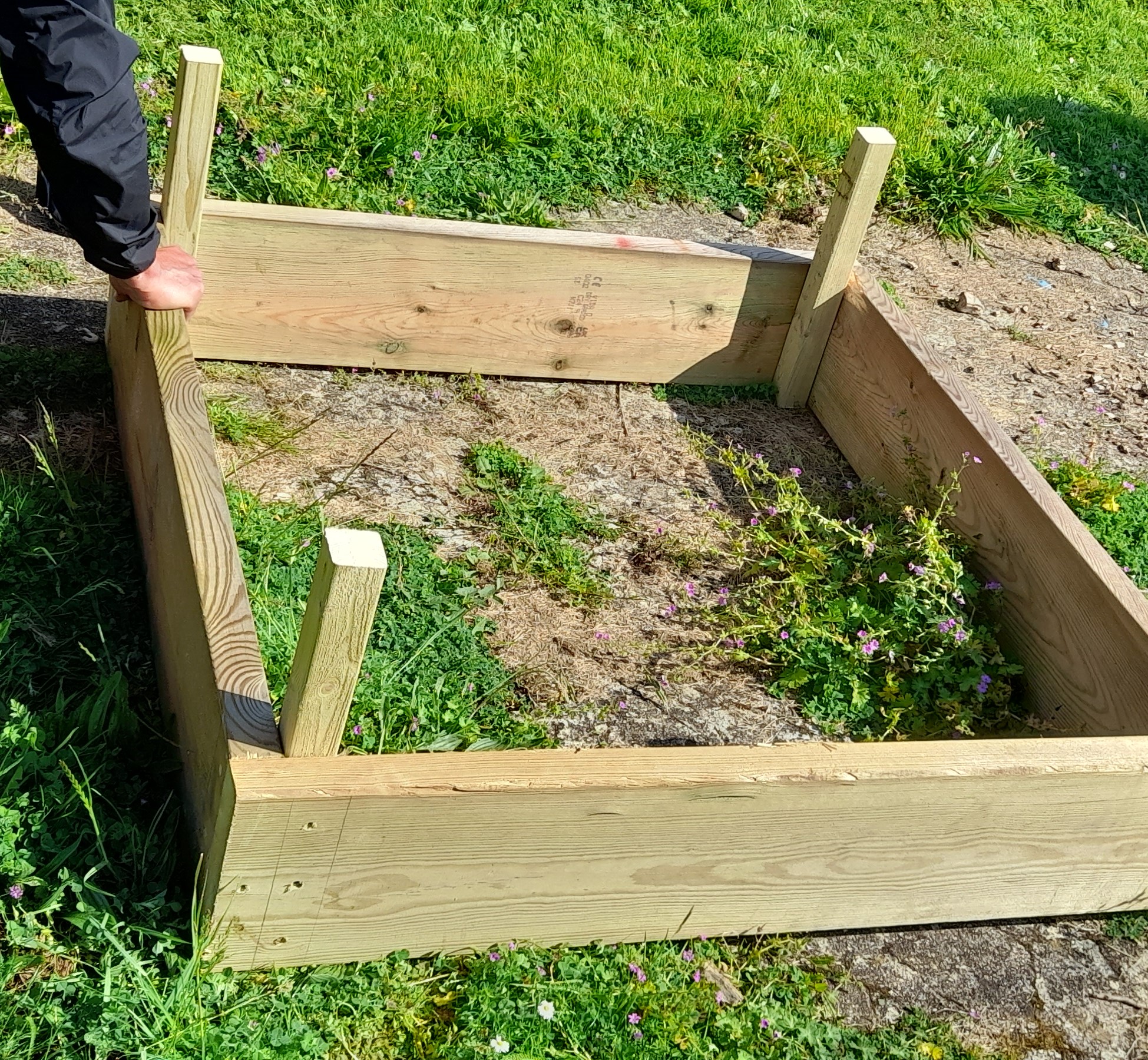
- Tanalised baton: 50mm x 50mm x 2.4m for corner supports
- 3” Deck screws used (about 50 for each bed – 4 boxes of 100 in total)
We bought the wood and screws from Timber requirements in Seaford and the Wood Creatives volunteers cut and pre-drilled the pieces. However, cutting the timber was a big job. Another local supplier, Wemban Smith in Lewes, can pre-cut wood.
You’ll see in the photos that the planks were cut into 2 shorter pieces and 2 longer pieces in order to create a square bed. In retrospect, it would have been just as easy to cut each plank into 4 equal pieces. The pre-drilled holes made assembly on the day much easier.
5. Equipment:
Equipment we used on the day:
- Garden spades
- One or two garden forks
- Electric drills with spare batteries
- Linemarker spray
- Wheelbarrows
- Trugs and buckets
- Trowels
- Gardening gloves
- Scissors and secateurs
- Cardboard
- Lawnmower
4. The planting media:
Raised beds can be filled in lots of different ways. However, it’s always recommended to use a compost mix rather than soil. We filled the beds with a mixture of:
One third peat-free, organic compost. Any brand is fine, but make sure you’re buying compost, not soil improver (which is much lower in nutrients). We bought ours in bulk from a local supplier.
One third vermiculite. (why?)
One third seasoned bark chippings or coir. We were able to source bark chippings from a local saw mill, where they are a waste product. This is not the same as sawdust from fresh, unseasoned wood, or woodchip from tree surgeons. A good alternative is coir.
This compost mix was developed by the Square Foot Gardening Foundation in the US and adapted and tested by GIA Director, Dan Ori. Although there is a higher initial cost, this compost mix
a) reduces water consumption by
b) is more structurally stable than straight compost and should last for approximately 10 years without the need for topping up, but just the addition of fertilzer.
The day before:
we delivered the wood and compost to the site the day before. We noticed that the grass had grown quite long, and so brought a lawnmower to cut the grass. If we do this again, we’ll do a site visit a couple of days before the project, and might even mow the grass (if needed), measure out and strip the turf a few days beforehand.
On the day:
1. We used linemarker spray to mark out where the raised beds would be. (Ours ran out – we should have bought a new can!)
2. Stripping the turf. The volunteers and older pupils used spades to strip the turf underneath where the raised beds would be. We removed perennial weeds then turned the turf over. For a video on stripping turf please visit (demonstration video). This was hard work, and took longer than we anticipated. However, the older pupils really enjoyed this job!
3. Assembling the beds. We found it was easiest to assemble the beds by joining the planks with a single screw, then fitting the centre baton.
4. Lining the beds. We lined the beds with a few layers of cardboard and the paper sacks the vermiculite came in to prevent unwanted plants growing through from the base. This was partly because we’d forgotten about this step so used what we had to hand. Next time, we’ll look at purchasing some landscaping fabric which will last longer and be more effective against the perennial weeds that we’d missed.
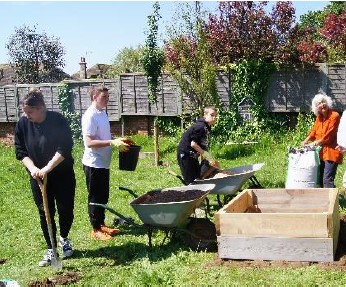
5. Filling the beds: at this point, the rest of the pupils came out to help us! We were able to borrow a number of wheelbarrows, and had a wheelbarrow for each bed. The pupils enjoyed collecting and mixing equal quantities of the different materials. Lots of buckets were useful for scooping and mixing.
Planting the beds: during the planning stage, the school and pupils had decided they wanted a mixture of plants for pollinators, sensory plants and to grow some vegetables. This is the plan we came up with. For more information about all of this please visit [section on food growing]
Future care: we plan to keep in touch with the school and see how they get on!