Collecting and storing rainwater – a case study
Case Study: Collecting and storing rain water
Dan Ori describes water storage and different methods of capturing and storing rainwater. (This information was presented at a workshop in June 2024.)
Planning ahead
- You can never have too much water in a community garden – so deciding how much water storage you need is about cost and space. How much can you afford to spend? How much roof space have you got? How much space have you got on the ground?
- At the Peverells, we built up our water storage over several years because we needed time to get funding and for our volunteers to carry out the installation. (See Planning Ahead for Water Consumption in Community Gardens for how to manage in the meantime.)
- Planning ahead and good preparation is key. Trying to move large water storage containers because they’re in the wrong place, or haven’t been correctly installed, is not easy!
Guttering and connector kits
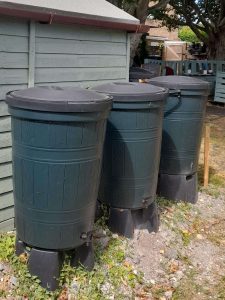
- Shed and greenhouse roofs usually need to be fitted with proper guttering to collect rainwater. You’ll also need connector kits. The cost of these can add up so make sure you budget for them and include in any funding bids.
- Gardening In Action is registered as a CIC (Community Interest Company) so we bought our guttering and kits from Parkers Building Supplies with our trade account (see links below). However, even if you’re not a CIC, local businesses are often very generous in giving discounts to local community causes, so it’s always worth asking.
Preparing the ground
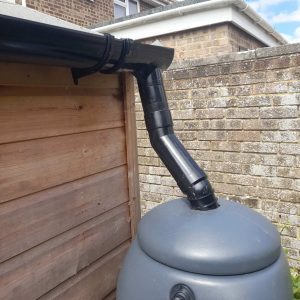
- Any sort of storage container gets very heavy once it’s full of water and needs to stand on a solid surface.
- All our water storage containers sit directly on the earth, so we levelled the area and then laid down several inches of road planings. Road planings are a waste product created during road works, and are a lot cheaper than equivalent materials. We used a fine grade. (See links below for where we bought them).
Water butts
- Even a small shed or greenhouse roof can collect a significant amount of water.
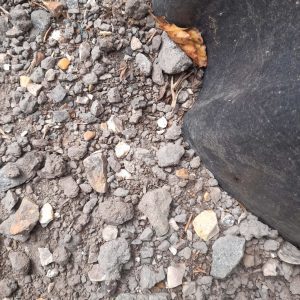
- We started by fitting 2 x 100 litre water butts to collect water from the shed roof, and subsequently added a third (see ‘daisy-chaining’ below).
- Since then, we’ve added water butts to our small shed and greenhouse, and are planning to add them to the polytunnel. If it’s got a flat surface we’ll collect water from it!!
- Slimline water butts are available for smaller spaces, but in general, larger is better. We’ve got both types of water butts, and have bought them from different suppliers. We sourced some that were made in the UK and were quite pleased with them. (See link below for where we bought them). Always make sure the water butt comes with a stand.
IBC Tanks
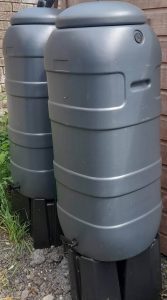
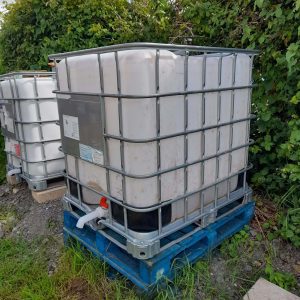
- To collect and store much larger amounts of water, IBC tanks can be used. (IBC stands for Intermediate Bulk Containers – in case you were wondering!). The tanks here holds 1100 litres.
- We were able to get hold of second-hand tanks for free (although we had to organise collecting them). The tanks previously contained glycerine. We washed them out using non bio washing-up liquid in an unused weed sprayer, rinsing them out and using the rinse water on non-edible plants in the garden. If you’re using second-hand tanks, make sure you know the contents were non toxic. Gardening In Action was able to organise free IBC tanks for a local school and for Friends of Sutton Downs. If you’re looking for free tanks we might be able to help – get in touch via the contact form. Otherwise, see the link below for purchasing new tanks.
- IBC tanks come in clear, misted or coloured plastic. Clear tanks need to be covered in a tarpaulin or roof to stop algae growing.
- Tanks in metal cages are best, because they’re more robust. But plastic cages are fine too.
IBC Tanks – additional considerations
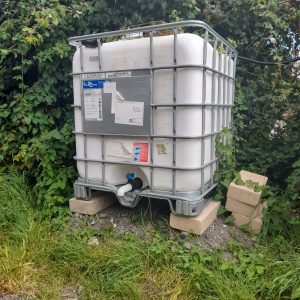
- We installed our first IBC tank on a pallet. Blue or red pallets are graded to take this amount of weight, but they’re difficult to get hold of, so the next tank was installed on concrete blocks after preparing the ground and laying down several inches of road planings. Even so, we’ve had some problems with the ground sinking, and next time we’ll prepare even more carefully!
- We connected our IBC tanks to a friendly neighbour’s garage roof. But always check you have the owner’s permission!
Connecting containers by ‘Daisy-chaining’
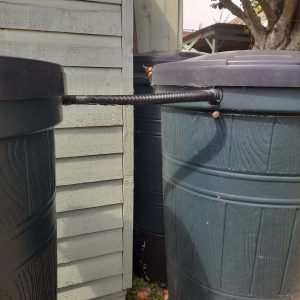
- We connected our water butts and IBC tanks by ‘daisy chaining’ them. Ie we have several containers all collecting water from a single down pipe.
- It’s best to connect them near to the top of the water butt or tank, as it’s then easier to sort out if the pipe gets clogged or if there’s a problem. (Ie you don’t have to empty the container).
- Ideally, connected water containers should slightly drop in level when they’re daisy chained. It’s OK if they’re on the same level, but they shouldn’t go uphill!
Health and safety
- Because the water in IBC tanks is under pressure, you need to be aware of the risk of legionnaire’s disease. This is only a risk if the water is atomised, or vaporised. This means water from IBC tanks should never be connected to a hose or sprinkler where water spray could be inhaled.
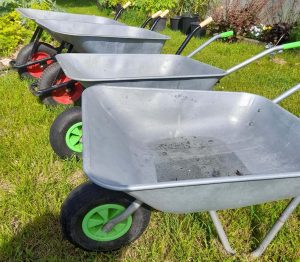
- If you ever collect water in open containers, you need to be aware of the risk of water-borne diseases. For example, foxes can carry something called Weil’s disease, which can be transmitted to humans. So if you’ve collected water in wheelbarrows, for example, always make sure volunteers wash their hands.
Vandalism
- One of the main vandalism problems community groups experience with their water butts is someone turning on a tap and letting all the water out. Some IBC tanks can be locked or closed with a chain, but this is more difficult for water butts. We’ve not found anything that would lock a water butt yet!
- Another problem can be people trying to tip over the tanks or water butts. IBC Tanks, when they have water in them, will be very difficult to move or tip over. Water butts can be chained or screwed to a wall to stop this happening. This is also useful where health and safety issues require it, such as on a railway platform.
- The Friends of Sutton Downs Group in Seaford have been able to create a secure enclosure for their water storage.
Links to suppliers:
Road planings supplier (tbc)
Water butt supplier (tbc)